






01
2022-08
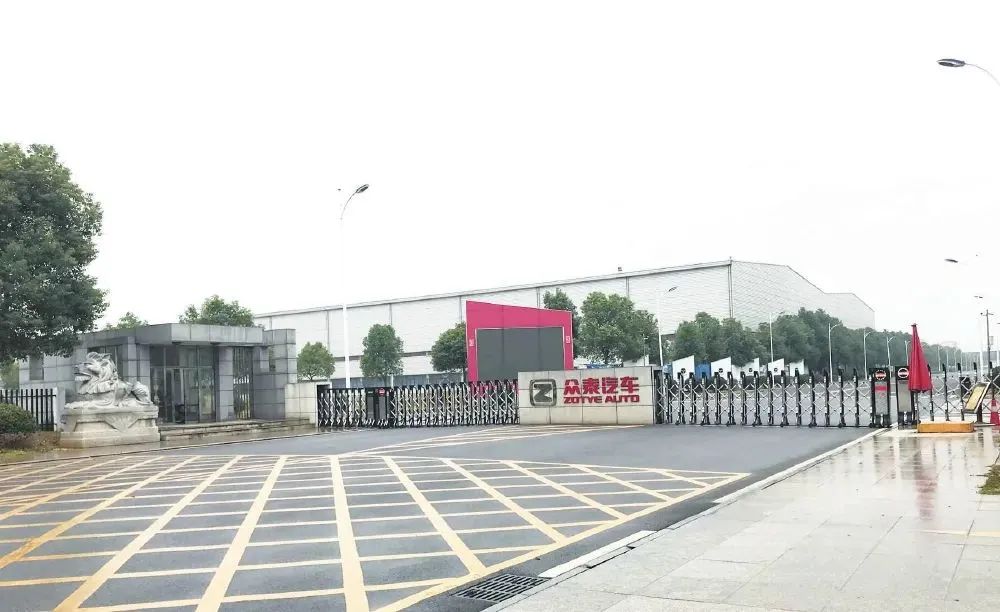
Partnering with Chongqing: Zotye Seeks Revival
On August 19, ST Zotye announced a cooperation agreement with the Bishan District Government of Chongqing, establishing a deep partnership in the development and construction of intelligent connected new energy vehicle (NEV) projects. Under the agreement, ST Zotye will establish an NEV R&D and production base in Bishan, upgrading existing facilities to create a production base with an annual capacity of 100,000 new energy vehicles.
Joining Hands with Bishan, Chongqing: Holding onto Revival Hopes
From its peak in 2016 to bankruptcy restructuring in 2020, followed by a 2 billion yuan investment from Jiangsu Shenshang in October 2021, Zotye has experienced significant ups and downs but has never abandoned its hopes for revival.
The NEV industry is currently booming, attracting players from both within and outside the sector, including those with no prior automotive experience. As one of the early domestic entrants in the NEV market, Zotye is determined to seize this opportunity.
In its 2021 annual report, ST Zotye stated that 2021 marked a significant turning point, with the company dedicating substantial efforts to support the restructuring process, maximizing stakeholder interests, and successfully completing the reorganization.
In June this year, ST Zotye announced a non-public stock issuance plan, aiming to raise up to 6 billion yuan by issuing no more than 1.52 billion shares to up to 35 specific investors. Of the funds raised, 4.73 billion yuan will be allocated to NEV and intelligent connected vehicle development and R&D capacity enhancement, 468 million yuan to channel construction, and 800 million yuan to supplement working capital. The NEV and intelligent connected vehicle development includes four models based on three platforms: three mid-to-large pure electric SUVs and one pure electric sedan.
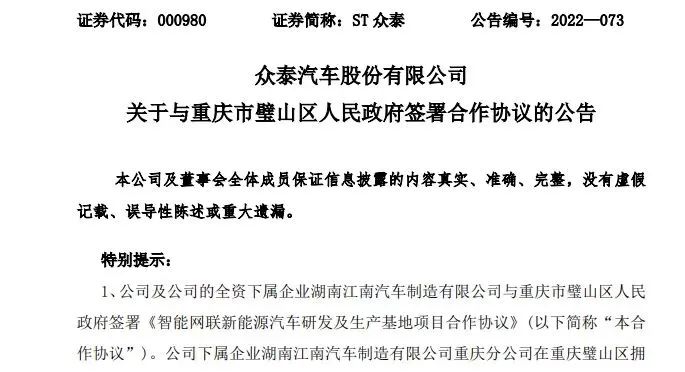
This partnership with Bishan, Chongqing, marks a substantial step toward resuming production.
Specifically, ST Zotye will lease and upgrade the production lines of the former Chongqing Zotye Automobile Industry Co., Ltd. to establish a production base with an annual capacity of 100,000 NEVs. Its subsidiary, Hunan Jiangnan Automobile Manufacturing Co., Ltd.’s Chongqing branch, holds a production capacity of 100,000 passenger vehicles in Bishan, approved by relevant government authorities. ST Zotye noted that the upgrade of the existing production lines will not significantly impact its financial position or operating results for the current year.
The Bishan District Government will fully support ST Zotye’s resumption of production and introduction of new models, providing assistance within its authority, including subsidies for the first two years of rent for the leased Chongqing Zotye assets. Further subsidies will be provided based on the sales volume of models produced and newly introduced by ST Zotye.
Zotye’s Path to Revival: Will History Repeat Itself?
Zotye Auto is making headlines again with a restructuring plan backed by new investors and local government support. On paper, everything seems to be moving in the right direction—but can the brand truly stage a comeback?
In the mid-2010s, Zotye gained national attention in China with models like the T600 Sport, SR9, and Damai X5. Its strategy of mimicking luxury car designs brought short-term success, propelling 2016 sales to over 330,000 units and placing the company among China’s top 10 domestic auto brands. Terms like “BaoShiTai” (a play on “Porsche” and “Zotye”) and “Tape Measure Department” became viral nicknames, highlighting the brand’s notoriety for imitation.
However, reliance on copycat designs proved unsustainable. Product quality issues and declining brand reputation led to a rapid sales drop: from 154,800 units in 2018 to just 116,600 in 2019. By 2020, Zotye was operating under severe financial distress, facing production halts, unpaid wages, and dealer disputes. In December 2020, its parent company, Tieniu Group, was declared bankrupt.

Zotye has since undergone multiple rounds of restructuring.
In October 2021, Jiangsu Shenshang Holdings signed a 2-billion-yuan investment deal to revive the automaker. But whether Zotye can survive in today’s fiercely competitive EV and smart vehicle market remains uncertain.
Industry analysts remain divided. Zhang Xiang argues that Zotye failed to keep pace with the shift to EVs and lacks competitive products. In contrast, Cui Dongshu, Secretary-General of the China Passenger Car Association, sees value in Zotye’s listed company status, suggesting it could offer strategic advantages if leveraged properly.
The road ahead may be challenging, but for Zotye, the opportunity to reinvent itself still exists.
Can Zotye and Chongqing Bishan Achieve a Win-Win Strategy?
Zotye’s latest collaboration with the Bishan District of Chongqing has sparked discussion: could this be the strategic use of Zotye’s resources that industry expert Cui Dongshu envisioned?
According to a recent statement from Zotye (ST Zotye), Chongqing Zotye Auto Industry Co., Ltd.—the partner in this project—is neither a subsidiary nor an affiliated company. The use of the “Zotye” name, they clarified, is mainly to leverage brand recognition for better material pricing and improved standing in the industry.
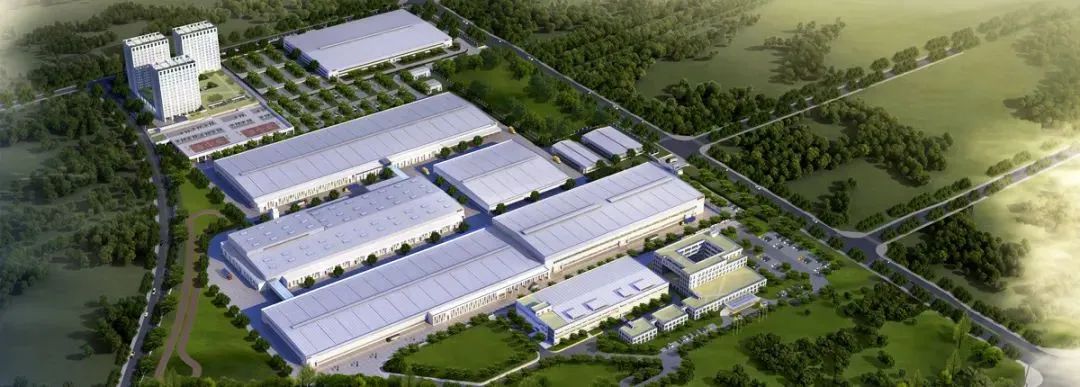
Earlier this year, assets belonging to Chongqing Zotye—such as land use rights, buildings, and materials—were listed for auction on Alibaba’s bankruptcy platform at an appraised value of 1.365 billion yuan. After the first round failed, a second auction was held at an 80% discount, but still drew no bids.
Fan Yongjun, Secretary-General of the Chengdu New Energy Vehicle Industry Association, noted that Zotye’s planned capacity of 100,000 units per year—less than 10,000 units per month—shows a cautious approach. Bishan’s local government appears even more conservative. The Chongqing Zotye assets, previously under Tieniu Group, are now managed by the Chongqing municipal government following a repossession. The failed auctions highlight the difficulty of asset disposal.
According to Fan, with no buyers or renters, the Bishan government has allowed Zotye to use the facilities rent-free for two years. Future subsidies will depend on Zotye’s sales performance. If Zotye fails, the government loses little; if it succeeds, the district gains in output, taxes, jobs, and economic activity. For Zotye, restarting production involves minimal investment.
“In essence, Zotye resumes operations at the lowest cost, while Bishan attracts investment with minimal risk. It’s a well-aligned, low-risk, win-win strategy,” Fan concluded.
04
Cash-Strapped and Lacking Tech, Can Zotye Really Make a Comeback?
A win-win setup doesn’t always lead to ultimate success. Despite recent efforts, skepticism remains strong around Zotye’s revival.
According to veteran auto industry analyst Wu Junsong, a true turnaround is unlikely as long as Zotye’s controlling shareholder remains unchanged. The 2 billion yuan investment from Shenshang Holdings was largely used for debt restructuring, and there’s no public evidence that the additional 6 billion yuan Zotye aimed to raise has materialized. In today’s EV industry, even 10 billion yuan may not be enough to stay competitive—Zotye, quite simply, lacks the necessary funding.
Furthermore, the EV market has already entered a phase of intense consolidation. Competing effectively now requires deep innovation in electrification, intelligent systems, and new marketing models. With rapid changes and fierce competition, only the strongest players can seize emerging opportunities.
Wu added that Zotye lacks the technical and managerial strength to escape its current position through internal growth. Without a powerful strategic investor with both capital and expertise—or a full acquisition—its chances are slim. “And really,” he asked, “who wants to be Zotye’s white knight?”
Fan Yongjun echoed this pessimism, noting that even at 4 yuan per share, Zotye’s planned 6 billion yuan private placement attracted no investors. The company’s legacy technology is now outdated—once viable under high subsidy policies, its models have since lost all competitive value. Developing new products would require major funding, and more importantly, Zotye’s damaged reputation due to copycat designs and quality issues remains a major obstacle.
“Right now, the odds of a full recovery are very low,” Fan concluded. “Unless Zotye plays a completely unexpected card, it may be best to rebrand entirely.”


